The Problem
I had decided to become more consistent with posting on LinkedIn.
Not because I wanted to become an influencer. I was beginning to understand that visibility matters.
The problem was that I was already spending most of my time building things.
I would spend hours debugging a problem, rethink part of a system, finally figure something out, commit the changes and move on.
Then, days later, I'd want to write about it.
And I'd struggle to remember the small details that made the experience interesting.
What went wrong? What did I try? Why didn't it work? What finally solved it?
Those details were often gone.
Git Remembers the Work. Not the Story.
Git is excellent at recording what changed.
But a commit like:
fix authentication issue
doesn't tell you that you spent three hours trying to understand the problem, went down the wrong path, discovered the actual cause and learned something along the way.
The work is there. The story isn't.
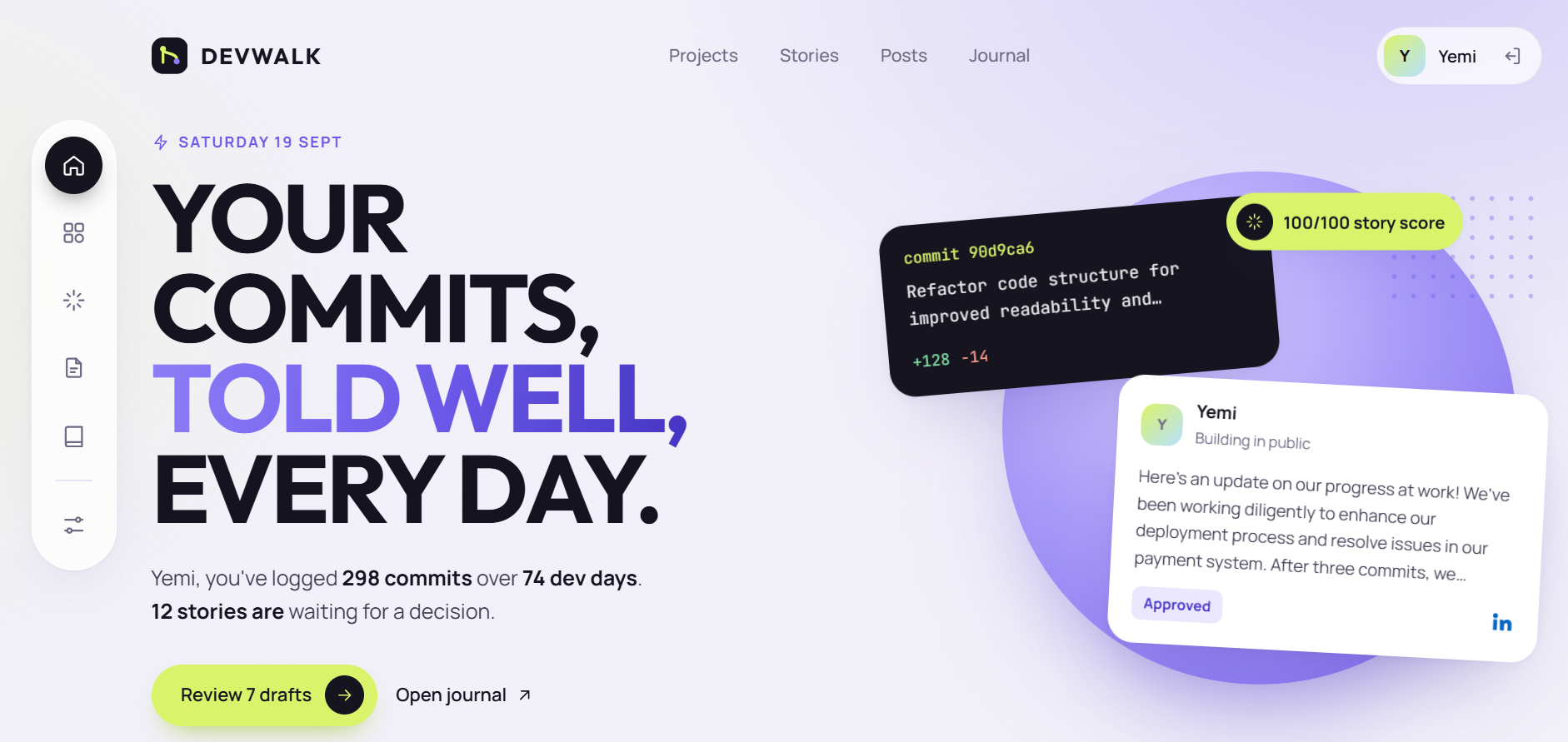
That was the idea behind DevWalk.
Your development history already contains stories. You shouldn't have to manufacture them from scratch.
How DevWalk Works
DevWalk looks at your Git activity and identifies meaningful development activity that could be worth documenting.
When Git isn't enough, you can add a quick note about what you were trying to solve or what you learned.
AI then helps turn that evidence into something you can actually share.
But there is an important distinction:
AI doesn't decide what happened.
Git provides the evidence. Rules identify meaningful activity. Your notes provide context. AI helps tell the story. You remain in control.
And if nothing meaningful happened, DevWalk can simply say:
NO STORY TODAY.
I think that's better than forcing content just to stay consistent.
Building With Privacy in Mind
DevWalk doesn't need your entire repository just to help you document your work.
The default approach focuses on development metadata such as commits, timestamps, changed files and insertion/deletion counts.
Projects can also use different privacy modes when deeper analysis is necessary.
The principle is simple:
Only collect what is necessary for the job.
Why This Matters
For me, DevWalk started with LinkedIn.
I was posting roughly once every three weeks to a month. Not because I didn't have anything to say, but because building and documenting started to feel like two separate jobs.
And I don't think developers need another job.
They already have stories.
The difficult bug. The architectural decision. The failed approach. The performance problem. The lesson learned.
The problem is that those stories are scattered across Git, editors, notes and memory.
DevWalk is my attempt to bring them together.
The principle is simple:
Show the work. Don't fabricate the work.
You keep building.
DevWalk helps make sure the work doesn't disappear.